
Why Professional Skin Care Beats Home Remedies
Skin care has become easier to discuss, search, and experiment with than ever before. Social media platforms are filled with homemade masks, natural ingredients, DIY scrubs, and quick skin care tricks. Some simple home-care practices can support healthy skin, but they are not suitable for every concern or every skin type.This is why understanding Why Professional Skin Care Is Better Than Home Remedies can help people make more informed decisions about their skin. Professional care begins with understanding the condition of the skin rather than simply trying an ingredient because it worked for someone else.A dermatologist can assess your skin, identify possible causes of a concern, recommend suitable products or treatments, and help you build a routine around your individual needs. Home care still has an important role. Gentle cleansing, moisturizing, sun protection, and other basic habits can support everyday skin health. The difference is that professional guidance helps you understand what your skin actually needs.
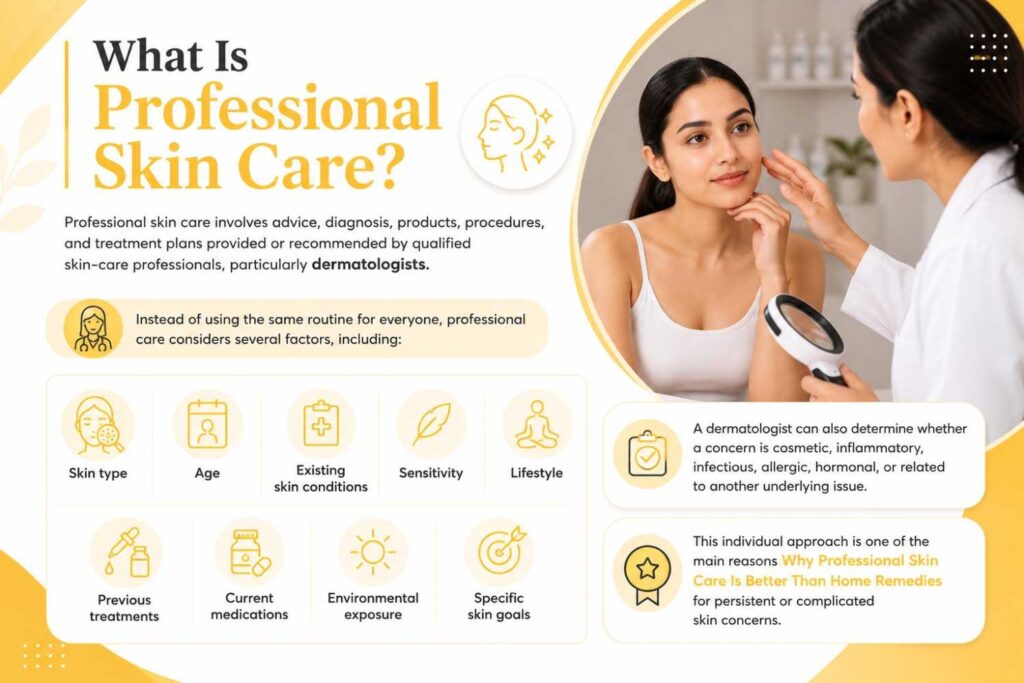
What Is Professional Skin Care?
Professional skin care involves advice, diagnosis, products, procedures, and treatment plans provided or recommended by qualified skin-care professionals, particularly dermatologists.
Instead of using the same routine for everyone, professional care considers several factors, including:
- Skin type
- Age
- Existing skin conditions
- Sensitivity
- Lifestyle
- Previous treatments
- Current medications
- Environmental exposure
- Specific skin goals
A dermatologist can also determine whether a concern is cosmetic, inflammatory, infectious, allergic, hormonal, or related to another underlying issue.This individual approach is one of the main reasons Why Professional Skin Care Is Better Than Home Remedies for persistent or complicated skin concerns.
Why Professional Skin Care Is Better Than Home Remedies
1. Professional Care Starts With Skin Assessment
One of the biggest limitations of home remedies is that people often begin treatment without knowing exactly what they are treating.For example, redness could have several possible causes. Dryness may result from environmental factors, irritation, eczema, or another condition. Similarly, bumps on the skin may not always be ordinary acne.A professional assessment helps determine what may be contributing to the concern before treatment is selected.Instead of asking, “Which home remedy should I try?”, a dermatologist can help answer a more useful question:“What does my skin need?”That difference can make skincare more structured and appropriate.
2. Professional Care Can Provide a More Personalized Routine
There is no universal skincare routine that works equally well for everyone.Two people may have oily skin but completely different concerns. One person may experience occasional breakouts, while another may have sensitivity or pigmentation concerns.
Professional guidance can help determine:
- Which cleanser may be appropriate
- Whether a moisturizer is needed
- Which active ingredients may be suitable
- How frequently products should be used
- Which ingredients should not be combined
- When sunscreen should be applied
- Whether a particular product should be avoided
This level of personalization is difficult to achieve with general DIY advice.
3. Home Remedies May Not Be Suitable for Every Skin Type
The word “natural” does not automatically mean that an ingredient is appropriate for the skin.A substance that feels comfortable on one person’s skin may irritate another person’s skin. Sensitive or acne-prone skin may react particularly strongly to certain ingredients or aggressive DIY methods.Professional skincare takes this variability into account.Rather than assuming that an ingredient is safe because it is commonly recommended online, professional care considers how the ingredient may interact with the individual’s skin.
4. Professional Guidance Helps Avoid Incorrect Product Combinations
Another common problem with DIY skincare is combining multiple ingredients without understanding how they interact.
People may use:
- Several exfoliating products
- Multiple acids
- Strong active ingredients
- Scrubs
- Homemade masks
- Retinoid-containing products
- Fragranced products
Using too many products can make the routine unnecessarily complicated and may increase irritation.Professional guidance can simplify the routine and help determine which products actually need to be included.
5. Professional Care Can Help Identify Underlying Skin Conditions
Some skin concerns may look simple from the outside but have different underlying causes.
Persistent:
- Acne
- Itching
- Dryness
- Pigmentation
- Rashes
- Redness
- Scaling
- Skin discoloration
- Unusual growths
may require proper evaluation.For example, the American Academy of Dermatology explains that itchy skin can have many possible causes, including eczema, hives, psoriasis, infections, and other conditions.Trying random remedies may temporarily change the appearance without addressing the underlying problem.Professional evaluation focuses on identifying the cause before deciding how the concern should be managed.
6. Professional Skin Care Uses Evidence-Based Approaches
Another important factor when comparing professional care with home remedies is the quality of evidence behind the approach.Online skincare trends often spread quickly because they are easy to demonstrate and share. However, popularity does not necessarily mean that a method has been properly evaluated.The AAD has similarly highlighted the growing popularity of DIY acne hacks and explains that not every at-home method is safe or effective. It recommends professional assessment because acne can differ from person to person.Professional skincare places greater emphasis on established dermatological knowledge rather than viral trends.
7. Professional Care Can Be Safer for Persistent Skin Concerns
Home care can be useful for basic skin maintenance, but persistent or changing concerns deserve more attention.For example, simple dryness may improve with appropriate moisturization. However, if dryness continues despite suitable care, it could sometimes be associated with an underlying condition.Similarly, persistent rashes, unusual changes, or concerns that repeatedly return may require professional evaluation.The goal is not to avoid home skincare completely. Instead, professional care helps determine when home care is enough and when additional assessment is needed.
8. Professional Treatments Can Go Beyond Basic Home Care
Home remedies are generally limited to ingredients and techniques that can be used without professional equipment.Dermatological care may provide access to clinically appropriate treatment options depending on the individual’s condition.Depending on the concern, a dermatologist may consider:
- Prescription topical treatments
- Medicated skincare
- Acne management
- Pigmentation management
- Treatment for inflammatory skin conditions
- Chemical exfoliation when appropriate
- Certain laser-based procedures
- Other dermatological procedures
Not every treatment is suitable for every person. A professional consultation helps determine whether a particular option is appropriate.
9. Professional Care Helps You Avoid Harmful Skincare Trends
The internet has changed how people discover skincare information.A short video can make a DIY treatment look simple, affordable, and effective. But online demonstrations rarely explain every possible skin type, contraindication, or potential reaction.This does not mean every home skincare tip is harmful. Basic practices such as gentle cleansing and moisturizing can be useful.The important point is to distinguish basic skin maintenance from treating a medical skin condition.
10. Professional Care Supports Long-Term Skin Health
Good skincare is not simply about improving the appearance of the skin today.
A professional approach can help people understand:
- Their skin type
- Their common triggers
- Suitable products
- Proper product usage
- Sun protection
- Skin-care habits
- When to seek medical advice
- Which trends to avoid
This knowledge can make everyday skincare more consistent.Professional guidance therefore becomes a learning process as well as a treatment approach.
Home Remedies vs Professional Skin Care
| Home Remedies | Professional Skin Care |
|---|---|
| Usually based on general advice | Based on individual assessment |
| May use household ingredients | Uses selected skincare or medical products |
| Limited ability to diagnose conditions | Can help identify possible underlying conditions |
| Results can vary significantly | Treatment can be adjusted according to response |
| May encourage experimentation | Focuses on appropriate product selection |
| Often influenced by social media | Based on dermatological knowledge |
| Suitable mainly for basic self-care | Can address persistent or complex concerns |
| No professional monitoring | Follow-up can be included when needed |
The comparison does not mean that all home skincare is inappropriate. Instead, it shows why professional guidance can be particularly valuable when a concern is persistent, recurring, sensitive, or difficult to identify.
When Should You Consult a Dermatologist?
Consider professional evaluation when:
- A skin concern does not improve with basic care
- A rash keeps returning
- Acne is persistent or worsening
- Skin becomes unusually sensitive
- Pigmentation continues to change
- You experience ongoing itching
- A new skin growth appears
- A product repeatedly causes irritation
- You are unsure which products to use
- You are considering a dermatological procedure
A dermatologist can help determine whether the concern requires treatment or whether simple skincare is sufficient.
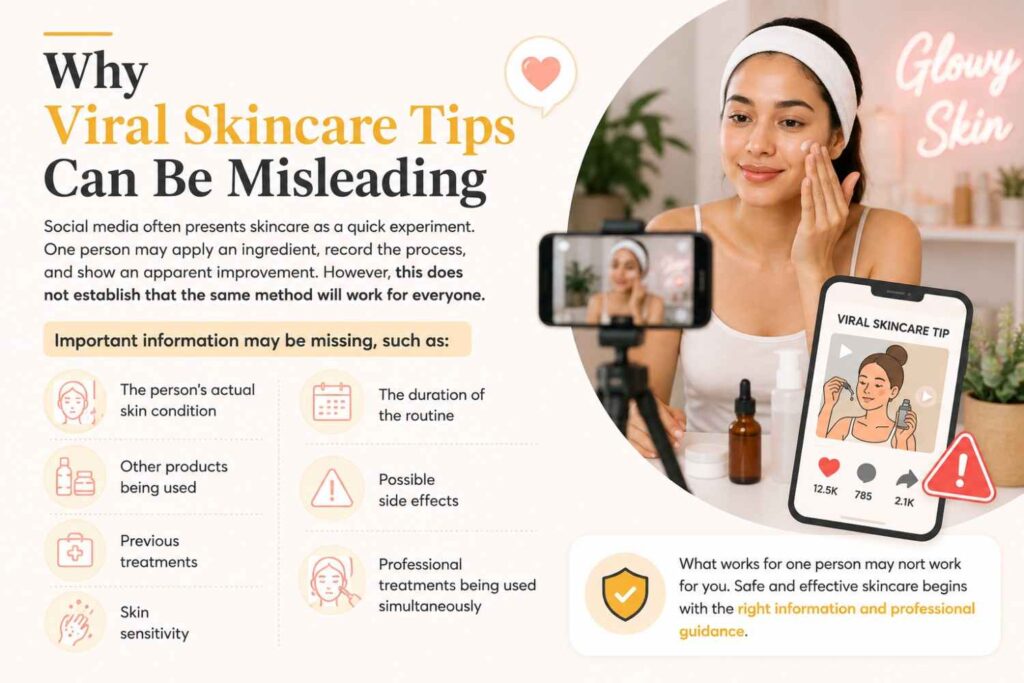
Why Viral Skincare Tips Can Be Misleading
Social media often presents skincare as a quick experiment.One person may apply an ingredient, record the process, and show an apparent improvement. However, this does not establish that the same method will work for everyone.
Important information may be missing, such as:
- The person’s actual skin condition
- Other products being used
- Previous treatments
- Skin sensitivity
- The duration of the routine
- Possible side effects
- Professional treatments being used simultaneously
Common Mistakes People Make With Home Remedies
- Using Too Many Ingredients
More ingredients do not automatically mean better skincare.
- Copying Someone Else’s Routine
A routine developed for another person’s skin may not suit your own.
- Scrubbing Aggressively
Physical irritation can make some skin concerns worse.
- Following Every Viral Trend
Popularity is not proof of effectiveness or suitability.
- Ignoring Persistent Problems
Repeatedly treating the same concern at home without understanding the cause may delay appropriate evaluation.
- Assuming Natural Means Safe
Natural ingredients can still cause irritation or unwanted reactions.
- Expecting Immediate Changes
Skin often needs time to respond to appropriate care. The AAD notes that many skincare products require weeks before their effects become noticeable.
Conclusion
Understanding Why Professional Skin Care Is Better Than Home Remedies can help people make more responsible skincare choices. Home remedies may appear convenient, but they are not automatically appropriate for every skin type or condition. Professional skincare focuses on assessment, personalization, appropriate products, evidence-based approaches, and ongoing guidance.At the same time, simple home habits such as gentle cleansing, moisturizing, and sun protection remain valuable parts of daily skin care. The most practical approach is not to completely reject home skincare. Instead, use basic home care wisely and seek professional advice when a concern is persistent, recurring, unusual, or difficult to understand.Knowing Why Professional Skin Care Is Better Than Home Remedies can help you choose a skincare routine based on your individual needs rather than relying on general DIY advice. This combination can make skincare more structured, informed, and suitable for your individual needs. (AAD). You can learn more about maintaining healthy skin and recognizing common skin conditions from the American Academy of Dermatology (AAD) .

Dr. Arathy Jerald
Dermatologist & Cosmetologist
Dr. Arathy Jerald is an experienced dermatologist and cosmetologist known for providing personalized skin and hair treatments. She focuses on combining medical dermatology with advanced aesthetic procedures to help patients achieve healthy and radiant skin.
Her approach emphasizes understanding each patient's unique concerns and creating customized treatment plans that enhance both skin health and natural beauty.
Revive Skin & Cosmetology Clinic, Palakkad, Kerala

